Language · Human factors · SMCP
An accent is not a failure, and fluent everyday English is not the same as precise safety communication. At sea, clarity comes from shared structure, disciplined listening and confirmation.

The channel removes useful clues
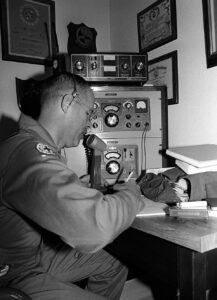
Radio strips away facial expression, gesture and much of the context that helps people understand one another. Seeing a speaker’s face is known to improve speech intelligibility substantially in noise; a radio listener has no such help.1 Noise, fading and clipped syllables also hit accented speech harder: experiments show that the intelligibility of non-native speech drops more than that of native speech as background noise increases.2,3
Standard phrases create common ground
IMO adopted the Standard Marine Communication Phrases (SMCP) in 2001 to get round language barriers at sea and avoid misunderstandings that can cause accidents.4,5 Their simplified maritime English and predictable patterns—including message markers such as QUESTION, INSTRUCTION, ADVICE and WARNING—help both speaker and listener anticipate the kind of information that follows.5 Under the STCW Convention, the ability to understand and use the SMCP is required for certification of officers in charge of a navigational watch on ships of 500 gross tonnage or more.4
Fluent everyday English is therefore not the same as competent safety communication: what matters on the radio is the shared, standardised form, not native-like fluency.
The SMCP prescribes how digits are pronounced, so that numbers survive accents and noise:5
0 ZEERO · 1 WUN · 2 TOO · 3 TREE · 4 FOWER · 5 FIFE · 6 SIX · 7 SEVEN · 8 AIT · 9 NINER · 1000 TOUSAND
Numbers are spoken digit by digit, and letters are spelled with the standard phonetic alphabet (Alfa, Bravo, Charlie …).
Do not pretend to understand
The dangerous response to uncertainty is a polite but inaccurate acknowledgement. Ask for repetition—the SMCP phrase is “Say again”—request a slower transmission, spell critical words and repeat back positions, numbers and intentions. The SMCP also lets a speaker safeguard an important part of a message with “Repeat …”, and correct an error with “Mistake … Correction …”.5 Confirmation protects both parties.
Clarity is a shared responsibility
Speaking more loudly rarely solves an accent problem. A measured pace, short sentences, standard words and deliberate pauses usually do more. Research on “clear speech” shows that deliberate speaking-style adjustments improve intelligibility in noise for both native and non-native listeners—even though the speaker’s accent remains.6 The listener must also suspend assumptions and verify the details that influence action.
References and further reading
- Sumby, W. H. & Pollack, I. (1954). Visual contribution to speech intelligibility in noise. Journal of the Acoustical Society of America, 26(2), 212–215.
- Rogers, C. L., Dalby, J. & Nishi, K. (2004). Effects of noise and proficiency on intelligibility of Chinese-accented English. Language and Speech, 47(2), 139–154.
- van Wijngaarden, S. J., Steeneken, H. J. M. & Houtgast, T. (2002). Quantifying the intelligibility of speech in noise for non-native talkers. Journal of the Acoustical Society of America, 112(6), 3004–3013.
- International Maritime Organization. Standard Marine Communication Phrases.
- IMO (2001). IMO Standard Marine Communication Phrases, Resolution A.918(22), adopted 29 November 2001.
- Smiljanić, R. & Bradlow, A. R. (2011). Bidirectional clear speech perception benefit for native and high-proficiency non-native talkers and listeners: Intelligibility and accentedness. Journal of the Acoustical Society of America, 130(6), 4020–4031.
- Image: U.S. Coast Guard / PO3 MyeongHi Clegg, “Radio communications”, 20 December 2013. DVIDS 1144086. Public domain.