When the passenger liner Republic was struck in fog in 1909, wireless telegraphy helped turn a collision into a coordinated rescue. The story became an early demonstration of radio’s value at sea—but later retellings often make it neater than it was.
Collision in the fog
On 23 January 1909, the White Star liner Republic was steaming east from New York when dense fog enveloped the waters south of Nantucket. The Italian liner Florida, carrying many emigrants, emerged from the fog and struck Republic amidships. The impact caused severe damage and flooding.
The collision itself killed people aboard both vessels. The claim that wireless “saved everyone” is therefore incorrect. What followed, however, was one of the first major maritime emergencies in which radio helped summon assistance over distance and sustain a rescue operation.
Jack Binns and CQD
Republic carried a Marconi wireless installation operated by John “Jack” Binns. After the collision he transmitted the distress signal CQD and the ship’s position. CQD had been introduced by the Marconi company; it was not an abbreviation for “Come Quick, Danger,” despite a popular later explanation.
Stations ashore and ships at sea received or relayed the calls. Radio did not provide today’s automatic identity, position and alert routing. Messages were keyed by hand, reception varied, and the operator remained at his apparatus while the ship lost power. Batteries helped keep the station working.
Rescue by ships, not by radio alone
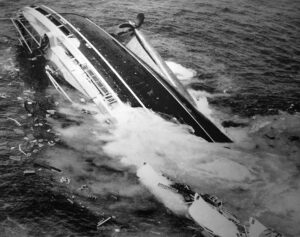
Wireless brought potential rescuers into the picture, but seamanship completed the rescue. Passengers were transferred between damaged ships and then to assisting vessels. The White Star liner Baltic reached the scene after a difficult search in fog. Republic later sank while under tow on 24 January.
The episode demonstrated a pattern that remains important: an alert has value only when it can be interpreted, located and converted into action. Operators, masters and crews built a shared picture from fragments of information and moved people to safety under difficult conditions.
Why the story mattered
Newspapers made Binns an international celebrity, and wireless gained public credibility as safety equipment rather than a commercial novelty. The disaster preceded the sinking of Titanic by three years and contributed to the wider debate about radio carriage, continuous listening and international regulation.
It would be misleading to draw a straight line from one casualty to modern GMDSS. Regulation developed through many conferences, accidents and technical changes. Yet Republic offered unusually visible evidence that a ship beyond visual range could call a network of strangers to its aid.
From CQD to a global system
SOS had already been adopted internationally by the time of the collision, although Marconi practice and the transition between signals were not uniform. The Republic case therefore belongs to an unsettled period in which company procedures, national rules and international agreements overlapped.
Today a distress alert may carry a digital identity and position and may be routed through terrestrial or satellite systems. Human follow-up is still essential. The technology has changed profoundly; the operational need revealed in 1909—connect the casualty with people able to act—has not.
Sources and further reading
- Library of Congress: contemporary newspaper coverage, 25 January 1909
- Smithsonian National Museum of American History: maritime wireless collection
- International Telecommunication Union: history of the Radio Regulations
Editorial note: Contemporary accounts vary in detail, and later popular narratives often simplify the signalling history. This article distinguishes the fatalities caused by the collision from the subsequent evacuation. Last fact-checked: 1 September 2026.