Maritime history · Collision · Rescue
In dense fog off Nantucket in July 1956, two radar-equipped liners formed incompatible pictures of the same encounter. Their collision became both a warning about new technology and the beginning of a remarkable rescue.
On the evening of 25 July 1956, the Italian liner Andrea Doria approached New York from the east while the Swedish liner Stockholm headed outbound. Fog lay over one ship; visibility around the other changed as the vessels closed. Both had radar. Both detected another target. Neither developed a shared understanding of how they would pass.
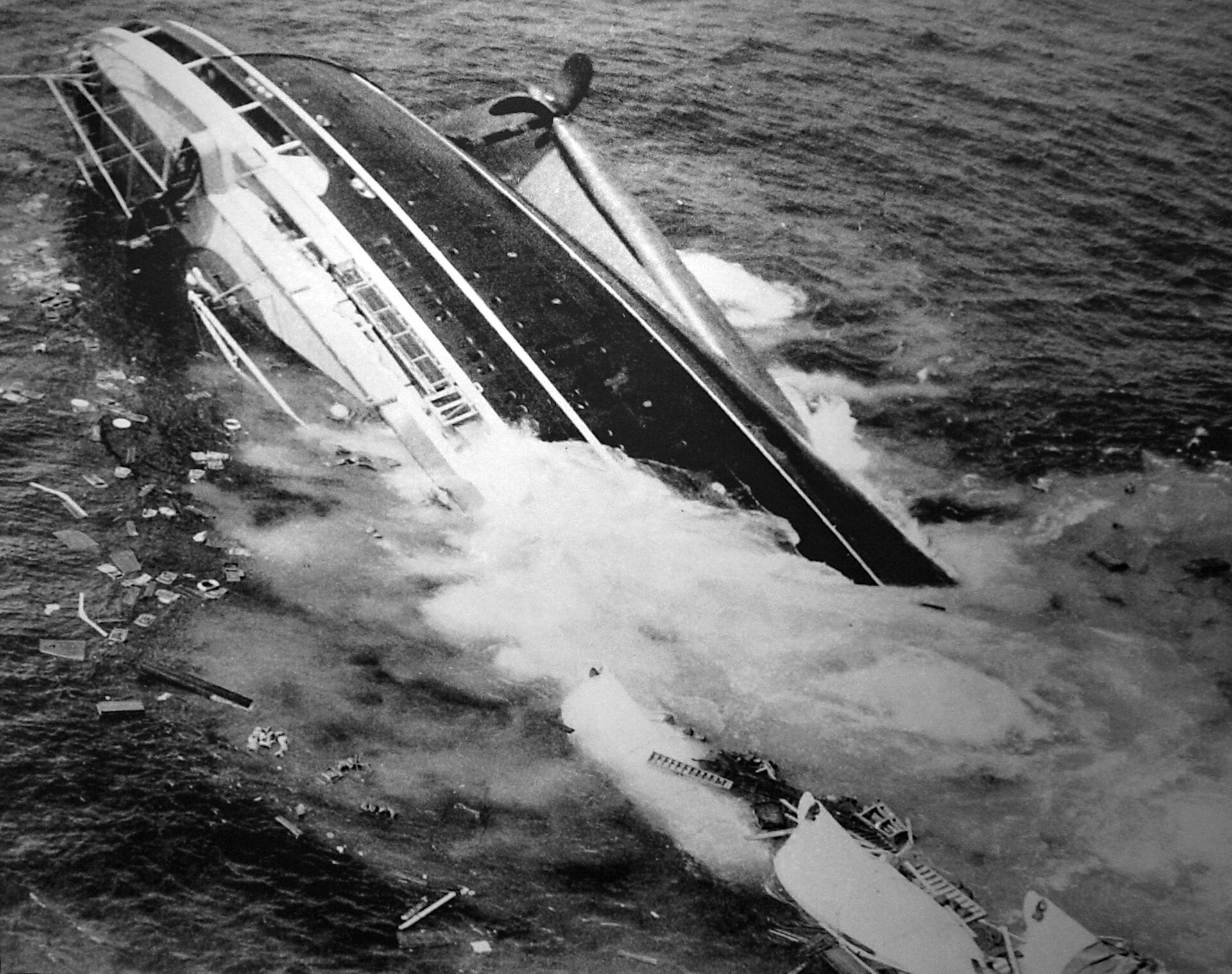
Shortly after 11 p.m., Stockholm‘s reinforced bow entered Andrea Doria‘s starboard side. The impact killed people aboard both ships and opened the Italian liner to the sea. Stockholm remained afloat despite catastrophic bow damage. Andrea Doria developed a severe list that made many lifeboats on one side unusable.
Radar without a common picture
Popular accounts often reduce the collision to one wrongly read radar screen. The historical record is more complicated. Officers aboard the ships interpreted the relative bearing and intended passing differently. Courses and manoeuvres that each bridge believed would increase separation instead brought the vessels together.
Radar could reveal a target through fog, but 1950s equipment did not automatically provide the complete tracked picture familiar on modern bridges. Range, bearing, relative motion, plotting, equipment settings and human interpretation all mattered. Radar was an aid to navigation, not a substitute for the collision regulations or disciplined assessment.
Two ships can detect each other and still fail to understand the encounter between them.
The conversation that did not happen
The bridges did not use radio to establish a shared passing arrangement before the collision. It is tempting to conclude that one conversation would certainly have prevented it. That cannot be proven. Radio exchanges can themselves be misunderstood, and collision avoidance remains governed by navigation rules rather than private negotiation.
Still, the absence of direct communication became part of the event’s enduring meaning. Radar information remained inside two separate mental models. No exchange exposed the contradiction while there was still room to clarify it.
Distress traffic changes the night
After the impact, radio became a means of coordination rather than avoidance. Distress signals brought Coast Guard stations, aircraft, cutters and nearby merchant vessels into the response. Stockholm, itself damaged, launched boats and took survivors aboard.
The French liner Île de France turned back toward the casualty. Its size, boats and experienced crew transformed the evacuation. Other ships—including Cape Ann, Thomas and Private William H. Thomas—also responded. Searchlights illuminated the listing liner and boats moved repeatedly between vessels.
The evacuation was difficult because Andrea Doria‘s list prevented normal lowering of many boats. Responding ships supplied the missing capacity. In an era before today’s integrated GMDSS, radiotelegraphy and radiotelephony enabled a fleet of independent vessels to assemble around one casualty.
Lives lost—and lives saved
Official Coast Guard chronology records 52 deaths resulting from the collision. More than 1,600 people survived the two ships, and the great majority of those aboard Andrea Doria were evacuated before she sank the following morning.
The rescue does not cancel the navigational failure. Nor should the failure conceal the rescue. The same event demonstrates two sides of maritime communication: information that remains fragmented can allow danger to grow, while information shared after disaster can organise extraordinary assistance.
An inquiry without a simple verdict
Hearings began in New York, but the shipowners reached a settlement and the proceedings ended before producing the kind of final, comprehensive allocation of fault often assumed in later retellings. Testimony, technical studies and later reconstructions have generated competing interpretations.
Responsible history therefore distinguishes established facts—the courses, collision, damage, distress traffic and rescue—from disputed explanations of precisely how each bridge perceived the approach. The lesson is not that radar failed. It is that technology supplies observations; people and organisations must turn them into a reliable shared picture.
In the fog, the two bridges never reached a common understanding. After the collision, dozens of stations did—and that difference saved lives.
References and further reading
- U.S. Coast Guard Historian’s Office. Chronology of Coast Guard History, 25 July 1956.
- U.S. House Committee on Merchant Marine and Fisheries. Report on the Andrea Doria–Stockholm Collision, 1956; catalogued by The Mariners’ Museum and Park.
- U.S. Naval Institute Proceedings. “There Must Have Been a Third Ship!” A contemporary analysis representing one interpretation of the evidence.