History · Technology · Maritime safety
Maritime radio evolved from noisy sparks and Morse code into an integrated distress system. The important story is not only how transmitters changed, but how regulation and rescue coordination grew around them.

When wireless meant sparks
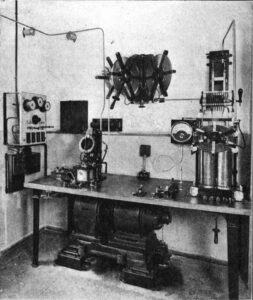
Early ship stations generated brief radio-frequency oscillations with electrical sparks and carried information by Morse telegraphy. Signals occupied broad slices of spectrum and depended on skilled operators.
Rules followed the technology
International radiotelegraph conferences began coordinating stations, distress signals and operating practice. SOS was established internationally in 1906; the 1912 conference strengthened common distress arrangements and listening requirements.
Reliable communication is not measured by how much was transmitted, but by what the receiving side can understand and act upon.
Voice, frequency and coordination
Vacuum-tube transmitters made continuous-wave telegraphy and radiotelephony practical. VHF later became central to short-range bridge-to-bridge and ship-to-shore communication, while MF and HF served longer distances.
The move to DSC and GMDSS
Digital Selective Calling added automated addressing and distress alerting. Under GMDSS, terrestrial radio, satellites, beacons, safety information and rescue organisations form a coordinated system. IMO adopted the principal SOLAS amendments in 1988; full implementation followed in 1999.